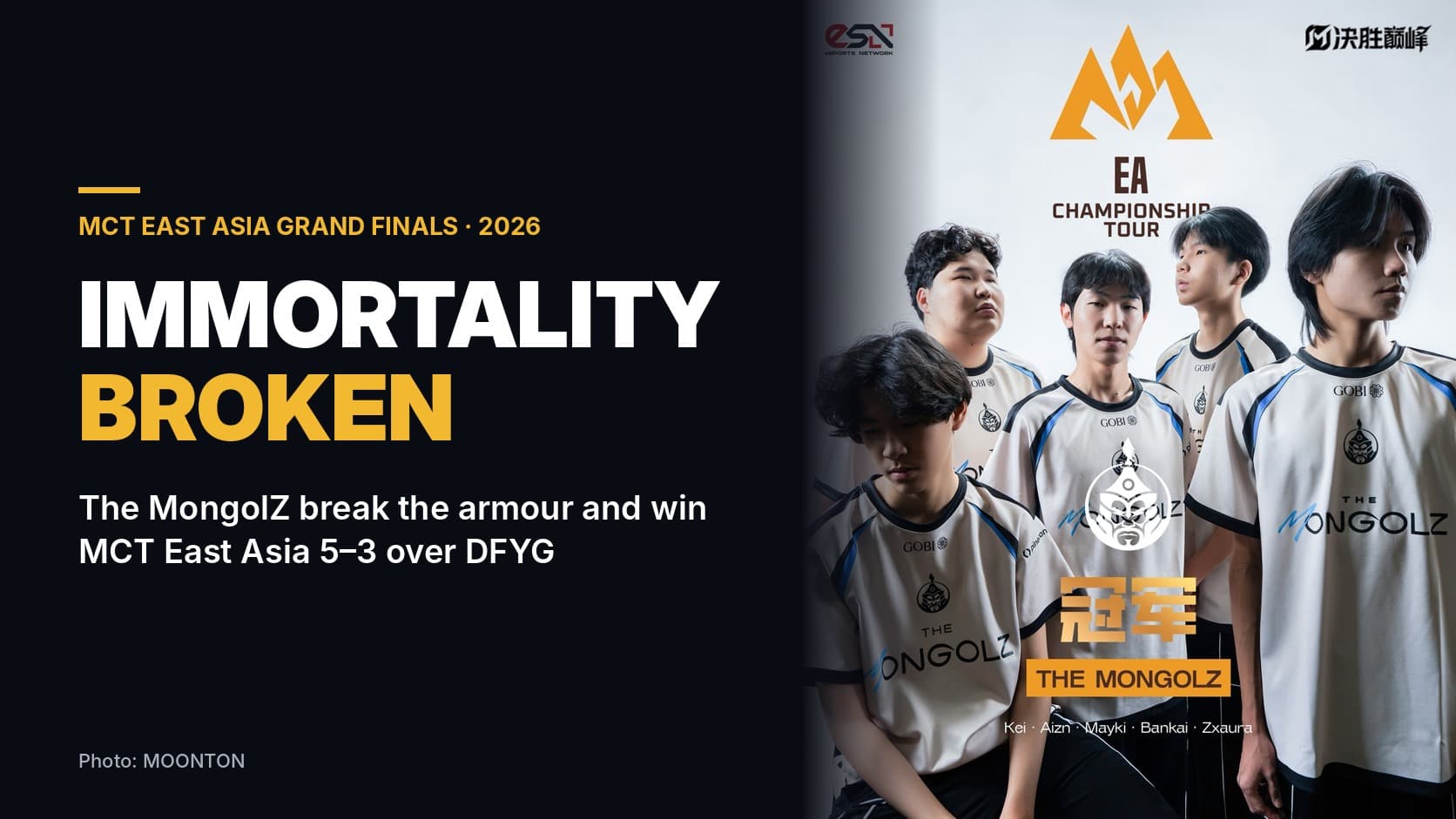
MCT EAST ASIA GRAND FINALS - 2026
Immortality Broken
The MongolZ lifting the trophy in front of the Ulaanbaatar crowd
EsportsKRONOS
EsportsKRONOS
The MongolZ made history in Ulaanbaatar, but the introduction of Immortality Armour could have implications far beyond one tournament. At SURGE Europe, we have been watching closely, because a change to how Grand Finals work is a change that could one day reach every region, Europe included.
For years, the Grand Finals of Mobile Legends: Bang Bang have followed a familiar formula. Two teams make it through the bracket, two teams fight for the trophy, and one team emerges as champion. But at the MCT East Asia Grand Finals, MOONTON introduced something that could change how we look at the final stage of competitive MLBB.
The new mechanic gave the Upper Bracket finalist, DianFengYaoGuai (DFYG), an additional opportunity to secure the championship after completing an undefeated run through the double-elimination bracket. It was a reward for consistency, but it also introduced an entirely new challenge for the team coming from the Lower Bracket.
And in its very first competitive appearance, that challenge was put to the test.
The concept behind Immortality Armour is relatively straightforward.
The Grand Finals begin as a Best-of-7, with the Upper Bracket winner needing four game victories to become champion. However, if the Lower Bracket finalist reaches four wins first, the armour breaks.
At that point, the advantage disappears and both teams need one additional victory to claim the championship. Should the score reach 4–4, the series proceeds to a winner-takes-all ninth game.
In short, the format rewards the team that navigated the tournament without losing a series, while still giving the Lower Bracket finalist a route to the title.
It is an interesting answer to a longstanding question in esports: how much should an undefeated Upper Bracket run be rewarded?
Traditionally, reaching the Grand Finals through the Upper Bracket brings advantages in preparation time, recovery and the number of matches played. Immortality Armour takes that reward a step further by directly influencing the championship win condition.
There could hardly have been a better introduction to the mechanic.
DFYG entered the Grand Finals with Immortality Armour, while Mongolia's The MongolZ had fought their way through the Lower Bracket, including a 3–0 victory over Guangzhou Gaming.
With the home crowd behind them, The MongolZ pushed the series to 3–3 before taking Game 7 and triggering the first-ever Armour Break.
The extra game was no longer simply a chance to extend the series. It was a chance to make history.
The MongolZ won Game 8, defeating DFYG 5–3 and becoming the first team to break Immortality Armour in an official MCT EA Grand Final. The result also secured their direct qualification to the M8 World Championship Main Stage.
What was introduced as a tournament experiment had immediately delivered a memorable competitive storyline.
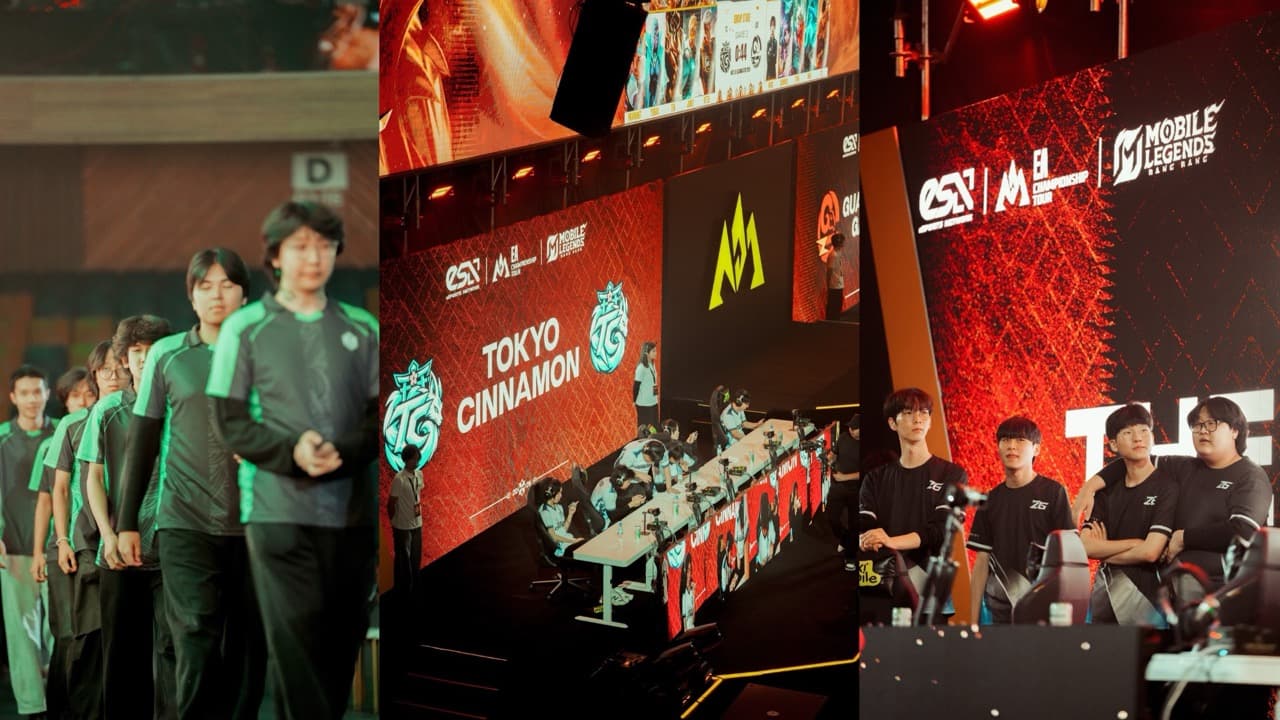 MCT East Asia teams on stage in Ulaanbaatar. Source: MOONTON
There are three major reasons why Immortality Armour deserves consideration beyond MCT East Asia.
The strongest argument in favour of the mechanic is that it makes an undefeated Upper Bracket run more meaningful.
Teams invest enormous amounts of time preparing for tournaments, and navigating a double-elimination bracket without losing a series is an achievement in itself. Immortality Armour recognises that achievement with an advantage that carries into the most important series of the event.
It also adds a strategic dimension. Teams must approach the Grand Finals knowing that their opponent has an extra layer of protection to overcome.
From a broadcast perspective, the format introduces a storyline that is easy for viewers to follow.
The armour is intact. The Lower Bracket team is fighting to break it. If they succeed, the championship is still within reach.
That creates natural moments of tension, anticipation and excitement. Instead of a Grand Final defined solely by the race to four wins, there is now an extra milestone that teams and viewers can rally around.
The MongolZ showed exactly how compelling that storyline can be.
Perhaps the most interesting aspect is that the Lower Bracket finalist is not ruled out simply because their opponent completed an undefeated run.
They can still become champions. They just have to overcome the advantage their opponent earned.
That strikes a balance between rewarding consistency and preserving the possibility of a comeback. And for a competitive ecosystem that keeps expanding into new regions, formats that set tournaments apart could also help them build their own identity.
As exciting as the concept is, there are legitimate arguments against rolling it out across the entire MLBB circuit.
The first is competitive fairness.
The Lower Bracket finalist has already fought through elimination matches to reach the Grand Finals. They have earned their place in the championship series, and some will argue that requiring them to win an extra game undermines the idea that both finalists should have an equal chance at the title.
Then there is fatigue.
A potential nine-game Grand Final is a significant commitment for players, coaches, production teams and viewers. The physical and mental demands of an extended series should not be overlooked, particularly when tournaments already run demanding schedules.
And finally, consistency.
Should every MLBB tournament use Immortality Armour? Would it work better in shorter regional competitions, or should it be reserved for major international events? Not every tournament has the same schedule, broadcast window or competitive structure. A format that works at MCT EA may not translate perfectly to an MPL season or the M Series.
These are questions MOONTON will need to answer before making it a standard feature.
Immortality Armour has the potential to become one of the more interesting innovations in MLBB's tournament structure.
It addresses a real question about the value of an undefeated Upper Bracket run, introduces a new competitive storyline and gives Grand Finals an extra layer of tension.
But its adoption should be measured rather than universal.
There is a strong case for continuing to test the format across selected MCT events and other regional competitions before considering it at the highest level. The M Series, MSC and MPL Grand Finals all carry different competitive expectations, and any change to their formats has to weigh fairness, player welfare, scheduling and the integrity of the championship.
Ultimately, the success of Immortality Armour should not be judged by how exciting its first appearance was. It should be judged by whether it consistently produces fair, competitive and memorable Grand Finals.
The MongolZ have already written the first chapter.
They broke the armour. Now the question is whether the rest of MLBB esports, from East Asia to Europe, will embrace it.